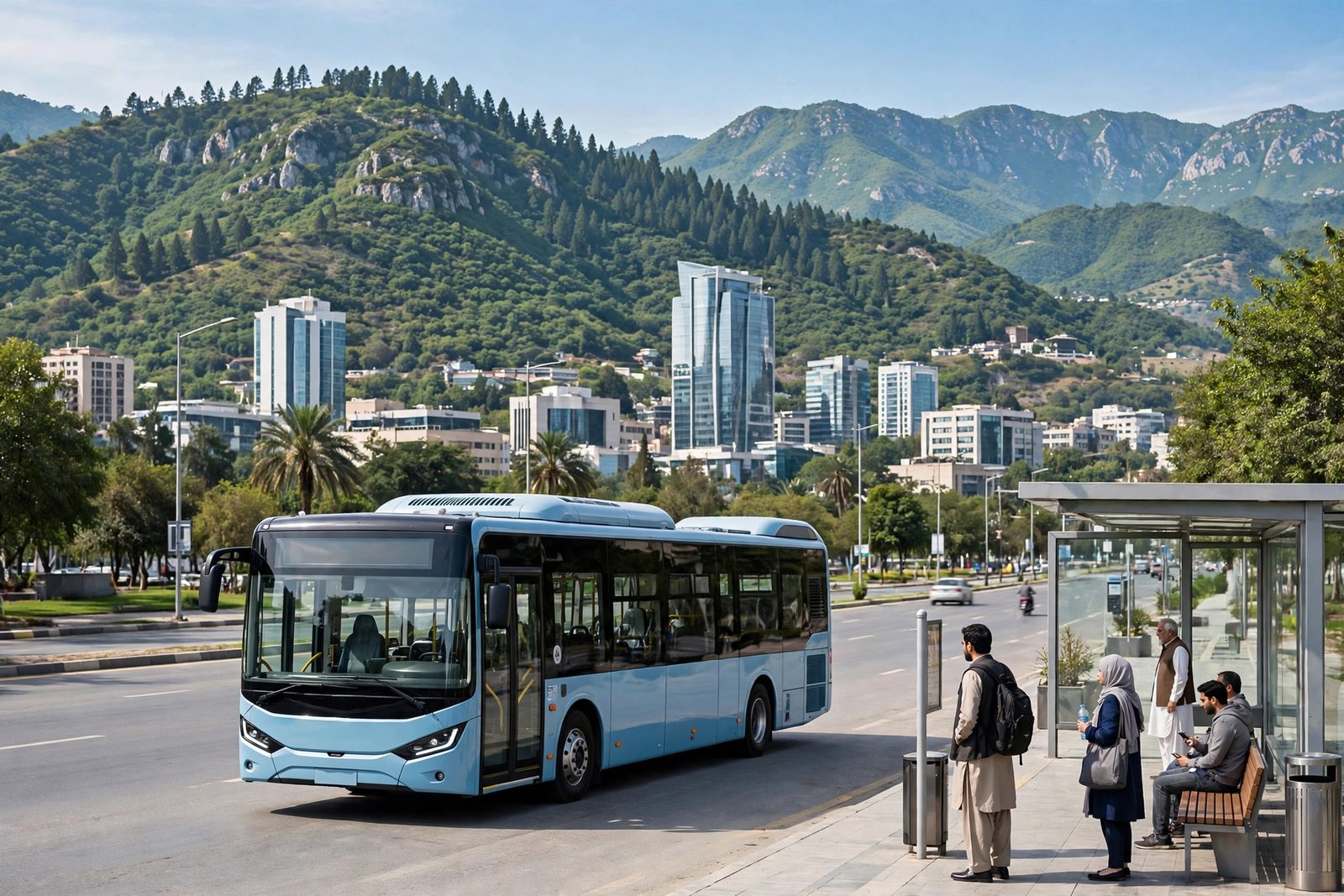
If you travel in Islamabad daily, the electric bus network is probably the easiest way to move around the city now. The Capital Development Authority runs around 160 modern, air-conditioned electric buses on 21 feeder routes, and the CDA says roughly 150,000 passengers use them every single day. That is a huge number — and it keeps growing.
Most of these routes are called feeder routes, or FR routes for short. They are numbered like FR-01, FR-04, FR-07 and so on. The smart thing about them is that they start or end at major metro stations, so you can hop off an electric bus and straight onto the Red, Orange, Blue or Green line without much walking. Think of them as the small roads that connect your sector to the big metro highways.
Electric Bus Islamabad Routes List (FR Routes)
Here are the main routes most commuters use. FR-01 runs between Khanna Pul and the NUST Metro Station, passing through I-9, I-10 and the NUST campus. FR-04 is one of the busiest — it goes from PIMS Hospital to Bari Imam and Quaid-e-Azam University, with stops at Melody Market, Aabpara, NADRA Chowk and the Serena Hotel area. Students and office workers rely on this one heavily.
FR-07 connects the PIMS Metro Station to the NUST Metro Station through G-8, G-9, G-10, G-11 and the Police Foundation. FR-08A runs from PIMS toward Taramri Chowk along Park Road, passing Shahzad Town and Chatta Bakhtawar. FR-05 links the Police Lines to D-12 and Shah Allah Ditta through F-10 and F-11 Markaz, which helps people in the western sectors a lot.
A few more routes cover the edges of the city. FR-08B connects Khanna Pul with Nilore, FR-09 runs between Khanna Pul and Golra Mor, and FR-14 serves the Barakahu to Mandi Mor corridor. FR-10 is the long one — it starts at Golra Mor Metro Station and goes all the way to B-17, Taxila and Wah Cantt. On weekends, special electric buses also run from PIMS to Daman-e-Koh and Shakarparian, roughly every hour, which is perfect for a family outing.
Timings, Fare & How to Ride
Most electric buses run from around 6:00 in the morning till about 10:00 at night, with buses coming every 10 to 15 minutes on busy routes. In September 2026, the Capital Mass Transit Authority improved the frequency on FR-08B, FR-09 and FR-14 — buses on these now arrive roughly every 12 minutes. Some routes have revised evening timings, so if you travel late at night, check the schedule before you leave.
The fare is simple: a flat Rs 50 per ride, no matter how far you go. The buses are electric, which means they are quiet, produce no exhaust smoke, and usually have decent seating with space for everyone. Route numbers are displayed clearly on the buses, and the timings are also integrated into Google Maps, so you can plan your trip from your phone.
For the best experience, reach your stop a few minutes early and keep small change or a digital payment option ready. Since these buses feed into the metro lines, they are usually cheapest when combined with a metro trip — for example, an electric bus to PIMS or Faizabad, then the metro onward. That combination can cut your daily travel cost down to very little.
Electric buses have genuinely changed how Islamabad moves. They are comfortable, affordable and better for the city’s air. Whether you are a student going to university, an employee heading to the office, or a family planning a trip to Daman-e-Koh, there is very likely an electric bus route that gets you close to where you need to be.