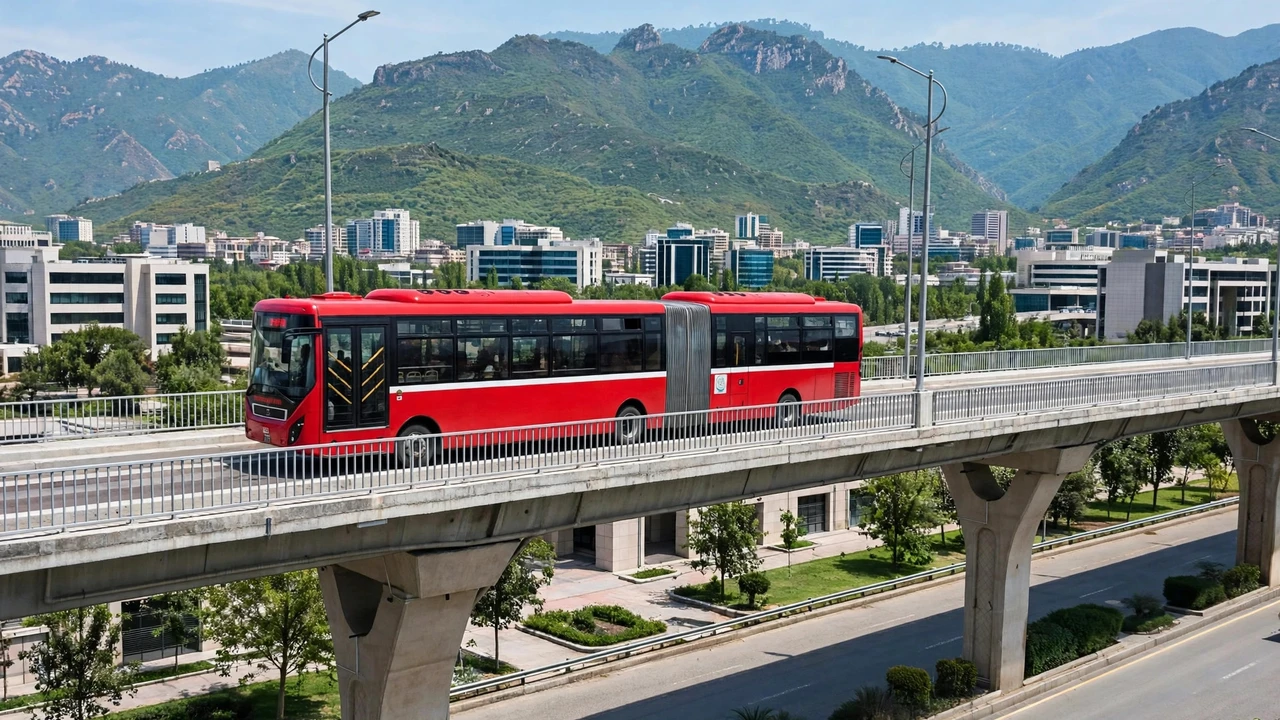
The story of the metro bus in Islamabad and Rawalpindi began long before the first bus rolled out, when daily traffic jams on the twin cities’ main roads made a fast, reliable public transport system a real need. After Lahore’s bus rapid transit showed that a dedicated corridor could work in Pakistan, planners turned to the Islamabad–Rawalpindi corridor, and construction on the first line began in February 2014. Just over a year later, commuters finally had a signal-free ride between the two cities.
The 2015 Launch: The Red Line Arrives
On 4 June 2015, Prime Minister Nawaz Sharif inaugurated the Rawalpindi–Islamabad Metrobus, making it the second fully functional bus rapid transit service in Pakistan after Lahore. The Red Line stretched around 22.5 kilometres between Pak Secretariat in Islamabad and Saddar in Rawalpindi, with 24 stations — 14 in Islamabad and 10 in Rawalpindi. Around 68 air-conditioned buses started on the route, and the project cost was reported at roughly Rs 44.84 billion, including the Peshawar Morr interchange.
What made the Red Line different was its dedicated, signal-free corridor. In Rawalpindi, about 8.6 kilometres of the track ran on an elevated structure, while the Islamabad portion ran mostly at ground level with underpasses and flyovers keeping buses moving. For thousands of daily commuters, the journey between Saddar, Faizabad, PIMS and Pak Secretariat suddenly became predictable, and the metro quickly became one of the busiest public transport options in the twin cities.
The 2022 Expansion: Orange, Green and Blue Lines
For seven years the Red Line carried the network alone, but 2022 changed that in a big way. The Orange Line, running about 25.6 kilometres from the Peshawar Morr Interchange to the New Islamabad International Airport, was inaugurated on 18 April 2022, finally giving air travellers a direct metro link. Then, on 7 July 2022, the Green and Blue Lines joined the network, running along Srinagar Highway and the Islamabad Expressway respectively, alongside regular traffic rather than on fully dedicated lanes.
This expansion also brought a new operator into the picture. While the Punjab Mass Transit Authority ran the original Red Line, the federal government created the Capital Mass Transit Authority (CMTA) to operate the Orange, Green and Blue Lines and future Islamabad routes. Together, the four lines took the whole network to around 83.6 kilometres with about 50 stops, turning a single corridor into a proper city-wide system.
From One Corridor to a Growing Network
Since 2022, growth has continued through feeder routes that connect neighbourhoods to the main metro stations, with new CDA feeder services added in 2024 linking areas like Bari Imam and Taramari Chowk to PIMS. Today, a commuter can start at Saddar, change at Faiz Ahmed Faiz for the airport, or board a Blue or Green bus towards Gulberg, Koral or Bhara Kahu. The metro’s history is therefore not just about one launch day in 2015, but about steady expansion from a single line into the network twin-city residents rely on every day.